
ADHD Blog
I Think I Might Have ADHD, What Now?
Your complete roadmap from suspicion to clarity—screening, understanding, assessment, and beyond.
That moment when everything clicks
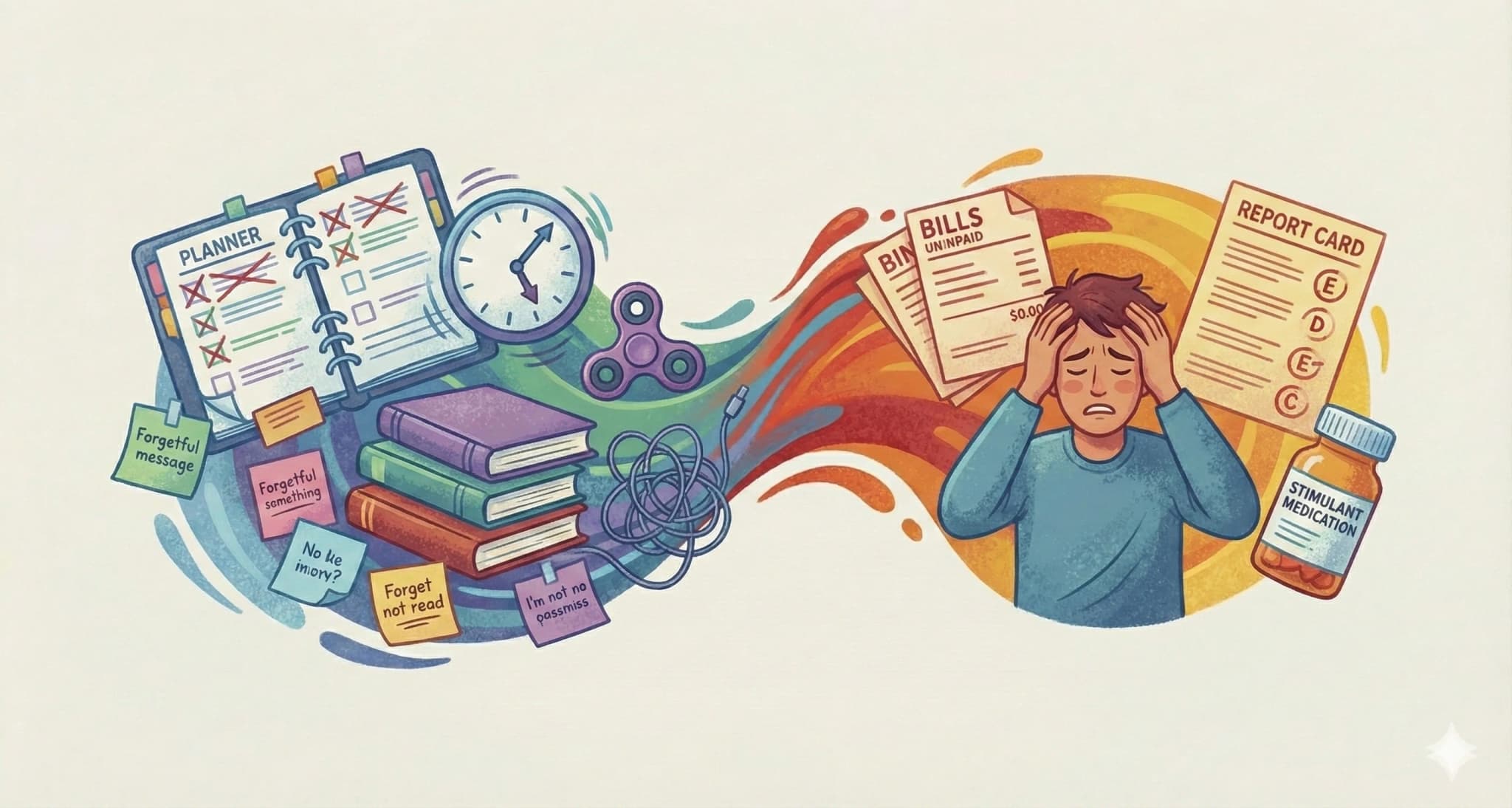
You are scrolling through social media and a post about ADHD stops you cold. It is describing you—the chronic lateness, the forgotten appointments, the mountain of unfinished projects, the way your brain feels like it is running 50 tabs at once while also buffering endlessly.
Or maybe it was not social media. Maybe it was a partner who gently suggested you look into it, or a child who got diagnosed and suddenly you saw your entire childhood reflected back at you, or a therapist who asked if anyone had ever screened you for ADHD.
However you got here, that moment of recognition can be overwhelming, validating, frightening, and hopeful all at once. And the immediate question that follows is always the same: what do I do now?
You are not imagining it—and you are not alone
First, let us be clear: if you suspect you have ADHD, you are not overreacting. ADHD in adults is common, under-diagnosed, and frequently misunderstood. The stereotype of a hyperactive child bouncing off the walls does not capture the reality for most adults, especially women and those who were considered "quiet" or "well-behaved" as children.
Adult ADHD often looks like chronic procrastination despite caring deeply, losing hours to tasks that should take minutes, emotional swings that feel out of proportion, difficulty following conversations even when you care about the topic, and a lifelong sense that you are working twice as hard as everyone else just to keep up.
Millions of adults are walking around undiagnosed, silently struggling and blaming themselves for what is actually a neurodevelopmental difference. Recognising the pattern is the first step—and it is a brave one.
Why adhd-tester.com is your starting point
When you first suspect ADHD, the internet can feel like information overload. You need clarity, structure, and trustworthy guidance—not just more noise.
That is exactly why adhd-tester.com exists. This is not a random blog or a symptom-checker that leads nowhere. It is a complete, free, evidence-based platform built specifically to take you from "I think I might have ADHD" all the way through to assessment-ready confidence.
Every tool, guide, screener, and resource on this site is designed to work together as a cohesive system—your golden ticket to understanding ADHD, your symptoms, and your next steps without feeling lost or overwhelmed.
Step 1: Take a validated screening tool—for free
The absolute first thing you should do is take a validated ADHD screening tool. Not a random quiz. Not a TikTok checklist. A real, evidence-based screener that clinicians actually use.
The ASRS (Adult ADHD Self-Report Scale) is the gold standard for adult ADHD screening. Developed by the World Health Organization and used in clinics worldwide, it asks 18 carefully designed questions about inattention, hyperactivity, and impulsivity.
On adhd-tester.com, you can take the full ASRS v1.1 screener completely free at /test. It takes about 5 minutes, and you will get an instant, structured breakdown of your responses across the key symptom domains.
You will also find shorter versions like the ASRS-5 at /asrs-v5, which is streamlined for quick checks, and a full library of regional and comorbidity screeners at /screeners.
These are not diagnostic tools—no online screener is—but they give you a clear, clinical-grade snapshot of whether your experiences align strongly enough with ADHD to justify pursuing a full assessment.
Why screening first matters
You might be tempted to skip straight to booking an assessment, but starting with a screener serves several critical purposes.
First, it helps you separate ADHD traits from other conditions like anxiety, depression, burnout, or thyroid issues that can mimic ADHD symptoms. Second, it gives you concrete data to bring to a clinician rather than vague descriptions. Third, it helps you decide whether pursuing assessment is worth the time, cost, and emotional energy.
And finally, taking a screener often brings a profound sense of validation. Seeing your experiences reflected in clinical language can be incredibly powerful, especially if you have spent years being told you are lazy, careless, or just not trying hard enough.
Step 2: Understand what you are experiencing
After screening, the next step is education—but not just any education. You need accurate, clinician-aligned information that helps you understand ADHD as a neurodevelopmental condition, not a character flaw.
ADHD Tester offers a full ADHD Glossary at /glossary with plain-language definitions of every major term you will encounter: executive function, time blindness, hyperfocus, emotional dysregulation, working memory, and more. Each glossary entry includes examples, context, and links to relevant tools and resources.
You can also explore the Resources hub at /resources, which covers ADHD diagnosis criteria, the DSM-5 framework, the ICD-11 approach used internationally, and regional diagnostic variations. The Resources section also links to diagnosis criteria pages like /resources/diagnosis-criteria and even the Chinese CCMD-3 framework at /resources/ccmd-3 for users in China.
Understanding the language of ADHD transforms the assessment process from something confusing and intimidating into something you can actively participate in with confidence.
Step 3: Learn how diagnosis works where you live
ADHD diagnosis is not universal. How you get assessed, who can diagnose you, how long it takes, and how much it costs varies massively depending on where you live.
ADHD Tester has dedicated country-specific diagnosis guides that explain exactly how the process works in your region. Whether you are in the US at /adhd-diagnosis/us, the UK at /adhd-diagnosis/uk, Canada at /adhd-diagnosis/canada, Australia at /adhd-diagnosis/australia, or over a dozen other countries including India, UAE, China, Europe, and more—there is a detailed guide showing you the public and private pathways, typical waiting times, expected costs, and what actually happens during assessment.
You can compare all the diagnosis options side by side at /adhd-diagnosis or jump straight to your country. No more Googling endlessly and piecing together unreliable forum posts. It is all here, structured and ready to use.
Step 4: Prepare for your assessment like a pro
Once you know where and how to get assessed, the next step is preparation. A good ADHD assessment is not a 10-minute tick-box questionnaire—it is a detailed clinical interview exploring your history from childhood to now, your functional impairment across multiple life domains, and any co-occurring conditions.
ADHD Tester has a dedicated pre-diagnosis page at /pre-diagnosis that walks you through exactly what to gather before your appointment: old report cards, examples of lifelong patterns, stories from family members, and a symptom journal documenting real-world impact.
But here is where ADHD Tester becomes truly unique: you can practice the entire assessment process before you even book an appointment.
The Clinical Readiness Session at /interview is a paid feature that lets you rehearse a full ADHD diagnostic-style interview using AI-powered clinician-style interview simulation. You will answer questions about your symptoms, childhood history, daily functioning, and comorbidities—and then receive a detailed written report summarising your responses in clinical language.
This is not a diagnosis. But it is an incredibly powerful preparation tool that helps you articulate your experiences clearly, identify gaps in your memory or documentation, and walk into a real assessment feeling confident and ready instead of nervous and unprepared.
Why the AI interview is a game-changer
Most people have never been through a clinical diagnostic interview before. They do not know what questions to expect, how much detail to provide, or how to describe abstract experiences like time blindness or emotional dysregulation in concrete terms.
The Clinical Readiness Session solves this. It is like having a dress rehearsal before opening night. You get to practice describing your symptoms, childhood experiences, and functional impairment in a low-stakes environment. You get to see which parts of your story need more detail and which areas you have not thought about yet.
And at the end, you receive a structured report summarising your responses—something you can review, share with trusted people, or even bring to a real clinician as supporting documentation.
For many users, this session is the moment when scattered experiences crystallise into a clear, coherent narrative. It is worth every penny.
Step 5: Understand overlapping conditions
ADHD rarely travels alone. Anxiety, depression, autism spectrum conditions, sleep disorders, and trauma-related conditions often co-occur with ADHD—and they can complicate both the assessment process and your daily life.
ADHD Tester includes in-depth guides on common overlaps. The Autism-ADHD Overlap guide at /blog/autism-adhd-overlap explains how traits blend, why so many people have both, and how to talk about this in an assessment. The ADHD vs. Anxiety vs. Depression article at /blog/adhd-vs-anxiety-vs-depression helps you tease apart symptoms that look similar but have different root causes.
You will also find comorbidity screeners in the Screeners section at /screeners, and the Resources hub at /resources includes links to trusted organisations specialising in co-occurring conditions.
Understanding comorbidities is not just academic—it directly impacts treatment planning and quality of life.
Step 6: Learn about ADHD pioneers and the science behind it all
One of the most empowering parts of understanding ADHD is learning from the researchers and clinicians who have dedicated their careers to it. ADHD Tester includes a Pioneers section at /pioneers featuring profiles of experts like Dr. Russell Barkley, Dr. Edward Hallowell, Dr. John Ratey, Dr. Gabor Maté, and others.
Each pioneer profile explains their contributions, their perspective on ADHD, and links to their books, talks, and resources. Reading their work helps you see ADHD through a compassionate, neuroscience-informed lens rather than the stigmatising narratives that dominate popular culture.
You will also find deep dives into methodology at /methodology, accuracy discussions at /accuracy, and a full FAQ at /faq answering the most common questions about ADHD, screening, diagnosis, and treatment.
The full picture: How all the pieces fit together
Here is the beauty of adhd-tester.com: every feature is designed to support the others. The flow is intentional.
You start with a free screener at /test to see if ADHD fits. You read the glossary at /glossary to understand the language. You explore your country's diagnosis pathway at /adhd-diagnosis to know where to go. You prepare using the pre-diagnosis guide at /pre-diagnosis and practice with the AI interview at /interview. You investigate overlaps using articles like /blog/autism-adhd-overlap and /blog/adhd-vs-anxiety-vs-depression. And you deepen your understanding through the pioneers at /pioneers and resources at /resources.
No other platform brings all of this together in one place. No other site takes you from first suspicion all the way through to assessment-ready confidence with this level of structure, care, and clinical grounding.
This is your golden ticket.
What happens after assessment?
Whether you receive an ADHD diagnosis or not, ADHD Tester remains a valuable resource.
If you are diagnosed, you can return to the screeners at /screeners to track your symptoms over time, explore management strategies in the Resources section at /resources, and use the AI interview at /interview periodically to check in on functional changes.
If you are not diagnosed but still struggle with executive function, time management, or focus, the glossary, strategies, and comorbidity resources remain just as relevant. Many of the tools and techniques that help people with ADHD are broadly useful for anyone with executive function challenges.
And if you feel lost at any point, the contact page at /contact is always open. Whether you need help finding the right screener, understanding your results, or figuring out which resource to use next, you can reach out.
Why this matters so much
For decades, adults with ADHD were told they were lazy, careless, unmotivated, or just not trying hard enough. They internalised shame. They built coping mechanisms that eventually crumbled. They watched peers succeed effortlessly while they worked twice as hard just to stay afloat.
Understanding ADHD changes that narrative. It replaces shame with clarity. It replaces self-blame with self-compassion. And it opens the door to real support, whether that is medication, therapy, coaching, accommodations, or simply knowing that your brain works differently and that is okay.
ADHD Tester exists because everyone deserves access to this clarity—not just those who can afford expensive assessments or who happen to live near specialists. The free screeners, the country guides, the glossary, the blog articles—these are all designed to democratise access to high-quality ADHD information so that no one has to stay lost, confused, or ashamed.
Your next step is simple
If you think you might have ADHD, the single most important thing you can do right now is take that first screener.
Go to /test. Answer the questions honestly. Look at your results. And then follow the pathway this site lays out for you step by step.
You do not have to figure this out alone. You do not have to piece together unreliable advice from random corners of the internet. You have a complete, structured, evidence-based system right here—and it is free to start.
This is your moment. This is your path forward. And ADHD Tester is your companion every step of the way.
Important disclaimer
This article is for informational and educational purposes only and does not constitute medical advice, diagnosis, or treatment. ADHD Tester provides screening tools and resources to help you understand ADHD and prepare for professional assessment, but it cannot replace a qualified healthcare provider. If you have concerns about ADHD or any other health condition, please consult a licensed clinician who can assess your individual situation and provide personalised care.
Ready to explore your ADHD traits?
Take our free ASRS-based ADHD screening to get a structured view of your symptoms before you speak with a professional.